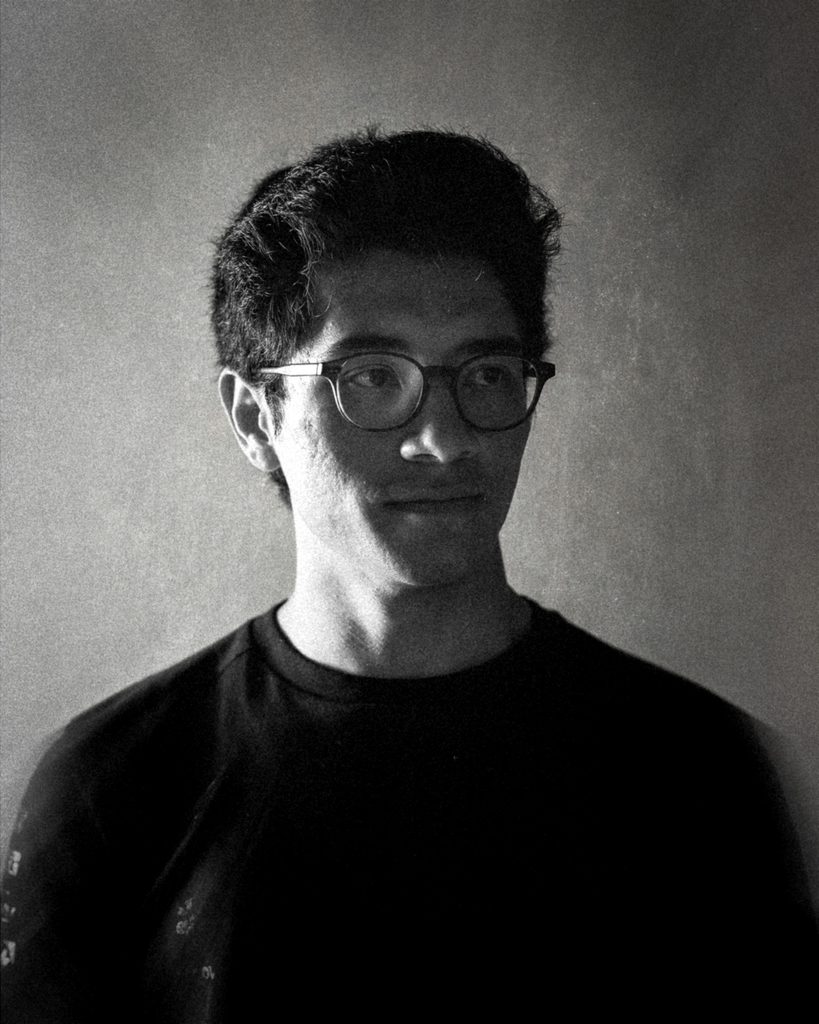
From a Creative Agency to the Moon: One Designer’s Unexpected Career in National Security
When people think about careers in national security, they often picture intelligence analysts, diplomats, or service members. But the field also relies on a wide range of talents, including the designers who shape how an organization tells its story. I sat down with Michael, a Nevada-based designer who works remotely for a defense and space company, to talk about how he got there and what his work really looks like.
What did you study in college, and did you ever picture yourself working in a national security–related field?
Michael studied Technology, Arts, and Media at CU Boulder, a program in the engineering school that blends design and engineering, with coursework ranging from robotics to photography and 3D printing. After graduating, he interned at a Reno creative agency, which became a full-time design job. Ready for his next step, he started applying widely on LinkedIn. National security was never the plan. “I hadn’t gone out of my way to apply into security or national defense,” he said. “It seemed like a good fit based on the job description and work.”
Did you take any classes outside of design, like writing, marketing, tech, international relations, or business, that ended up helping you?
Michael wishes he had invested more in writing and collaboration. “I do wish I did a little bit more writing or things that were more collaborative… because I have found it to be super useful now,” he said. A communications minor would have helped too, since design is a form of visual communication and having copyrighting skills on top of that is a bonus.
How did you find this job? Was it a deliberate move, or did you stumble into it?
He found the role on LinkedIn, and his main preparation was a personal website showcasing his agency work. In the interview, he walked through a project from start to finish and discussed his process and how he handles feedback. His lack of defense experience wasn’t a barrier. “Not a lot of it was focused on defense or national security,” he explained, “but what skills I had, how I was able to perform, and what I was interested in.”
Michael’s work supports the mission in two ways. One is advertising that ties the company to national goals, such as aligning an upcoming moon launch with NASA’s lunar vision. The other is attracting talent and investors by showing what the company can do and why it matters.
What does a normal week look like for a designer at a company like yours?
His work falls into three buckets: social media imagery, presentations for internal and external audiences like keynotes and customer pitches, and advertising in magazines, online, and at conferences or trade shows. Social media is constant, while the rest shifts with the company’s calendar.
What skills from design turned out to matter in ways you didn’t expect? And was there anything new you had to learn for the field you work in?
For Michael, the most valuable skills weren’t technical. “Oddly, there’s nothing from school that was super helpful,” he admitted. “The most important thing is being able to interpret what people want and then create that, and then have the ability to justify what you did.”
For new skills, he turns to YouTube. At a previous job with a small satellite company, he suddenly had to produce 3D satellite renders, something he had never done before, so he taught himself. “As long as they were happy with the result, they didn’t really care how I did it,” he said. “It’s really about being adaptable and okay with learning new things.”
What would you tell a high school or college student who loves art but never thought about this field? What’s one thing they could do now to set themselves up for a path like yours?
Michael’s first piece of advice is to keep art and design separate. “Art is something you do for yourself, and design is very specific with a purpose,” he explained. Someone above you often has the final say, and pouring your heart into a piece only to have it changed can be frustrating.
He also challenged the idea that designers must be naturally artistic. “People always say that because I am in design I am super artistic, but I’m actually not,” he said. “I just know how to use Photoshop and Illustrator, and take what people are saying and communicate it visually. That is what design is.”
Michael encourages artistic students to build the skills around the craft: pitching, interpreting what clients want, and strategy. Beautiful visuals alone aren’t enough. “You need to be able to give someone what they want and something that is effective for their goals.”
If you could give advice to someone applying for a role similar to yours, what would you say?
If Michael were hiring, he would look beyond the portfolio for candidates who can explain the brief, purpose, process, and reasoning behind their work. “Through those, you get an idea of someone’s thought process,” he said. “The actual design skills can be taught.” He also stressed being open to feedback, since his own work is often sent back for major changes, and being able to pivot quickly when priorities shift.
Many young people are now the youngest in their workplace, which can lead to imposter syndrome. Have you experienced this, what did you do, and what would you suggest to fellow youth?
When Michael started his previous job in 2022, he was four or five years younger than everyone on his team, and he still feels imposter syndrome around senior colleagues. One realization helps: “The thing I learned, at least with corporate America, is that often nobody really knows what exactly is going on.” His advice is to stay flexible and not take criticism personally. “Know when to save your breath and know how to change and adapt.”
Michael’s path shows that national security careers aren’t limited to clearances and briefings. The field needs communicators and creators, and the skills that matter most, such as adaptability, clear communication, and openness to feedback, are ones any student can start building today.
Leave a Reply